Resin Curing Time Review
Analyzing the critical balance between layer exposure, post-curing duration, and mechanical properties in SLA 3D printing.
Achieving optimal print quality and dimensional stability in stereolithography (SLA) requires precise control over exposure times. This trial report documents the effects of varying curing times during both the active printing phase and the post-processing stage. By testing multiple samples under controlled UV conditions, we isolated the correlation between exposure duration, layer adhesion, and mechanical performance.
Trial Setup & Material Parameters
The tests were conducted using a monochrome LCD SLA printer equipped with a 405nm light source. We selected a standard engineering-grade photopolymer resin for all iterations. The layer height was fixed at 50 microns to maintain consistency across all prints. The room temperature was regulated at 23°C to eliminate thermal variance as a factor in the curing rate.
- Light Intensity: 2.5 mW/cm² at the vat interface
- Base Layer Exposure: 25 seconds (5 layers)
- Layer Thickness: 0.05 mm
- Resin Viscosity: 300 mPa·s at test temperature
Exposure Time vs. Tensile Strength
We printed five sets of tensile specimens with normal layer exposure times ranging from 1.5 seconds to 3.5 seconds. Underexposure resulted in incomplete polymerization, causing delamination between layers under minimal load. Overexposure, on the other hand, led to light bleeding, which reduced dimensional accuracy and caused internal stresses that made the parts brittle.
Specimens cured at 2.2 seconds demonstrated the optimal balance. They achieved maximum tensile strength without sacrificing geometric fidelity. The sharp details of thin features were preserved, and the transition boundaries between layers remained clean and free of resin accumulation.
Post-Curing Dynamics
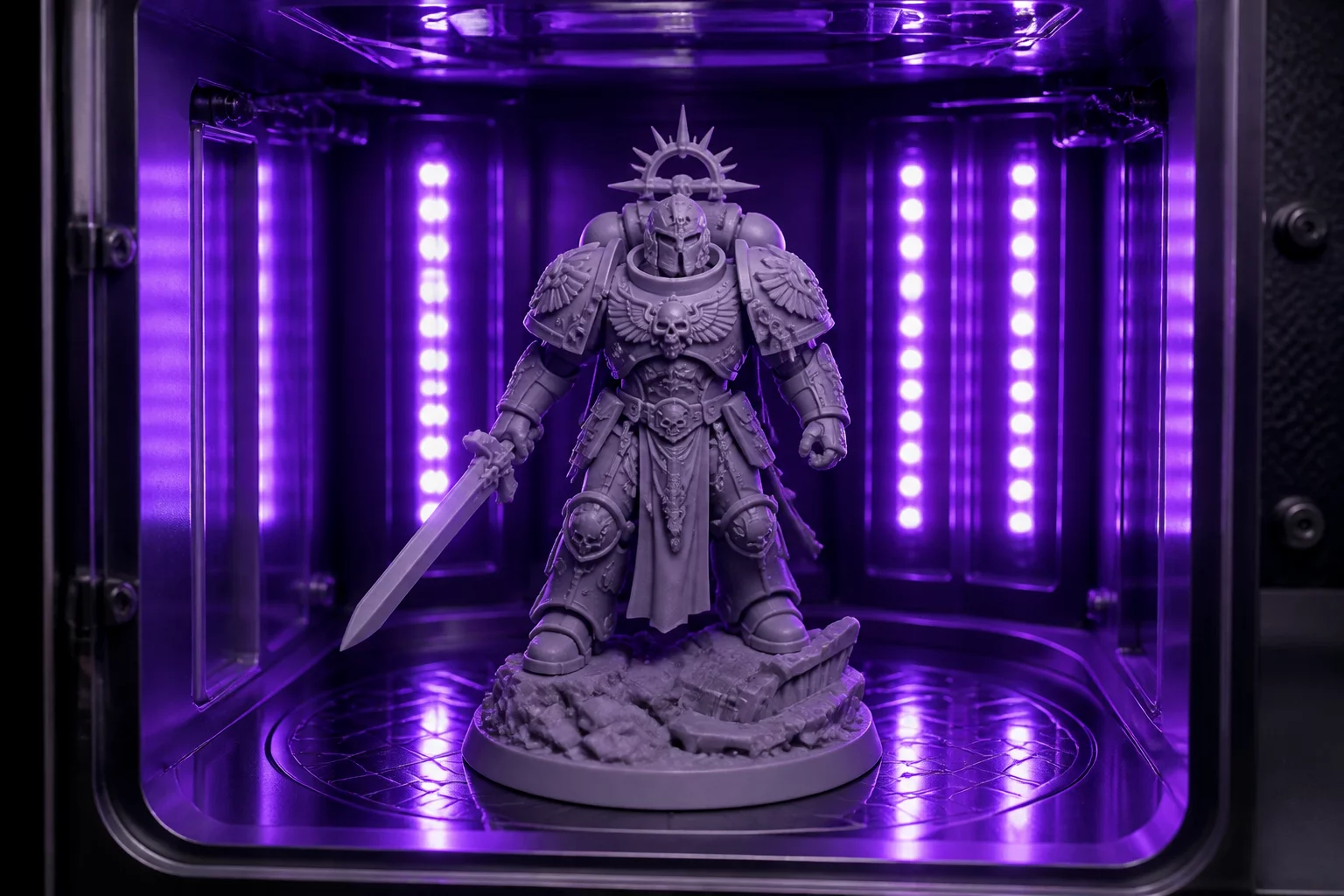
Post-processing trials were conducted in a dedicated chamber with 405nm UV LEDs and a rotating platform. Freshly washed parts were cured for periods of 5, 10, 20, and 45 minutes at 40°C. The results indicated that while a 5-minute cure left the surface slightly tacky, a 20-minute cycle fully polymerized the residual monomers. Extending the cycle to 45 minutes did not yield measurable improvements in hardness but did cause slight yellowing in clear samples.
Key Findings & Calibration Recommendations
Based on the collected data, we recommend establishing a standardized exposure calibration matrix before scaling production. A grid of small test geometries with incremental exposure steps allows operators to quickly identify the transition point from underexposed details to overexposed features. Regular maintenance of the light engine is also necessary, as UV output degrades over time, eventually requiring adjustments to the baseline exposure settings.
Trial Discussion
0No comments yet. This could be your first comment.
Add to the Context
To leave a comment, please log in to your account.