PLA Overhang Trial Report
Evaluating the limits of unsupported geometry in FDM printing to establish baseline parameters for industrial prototyping and aesthetic finishes.
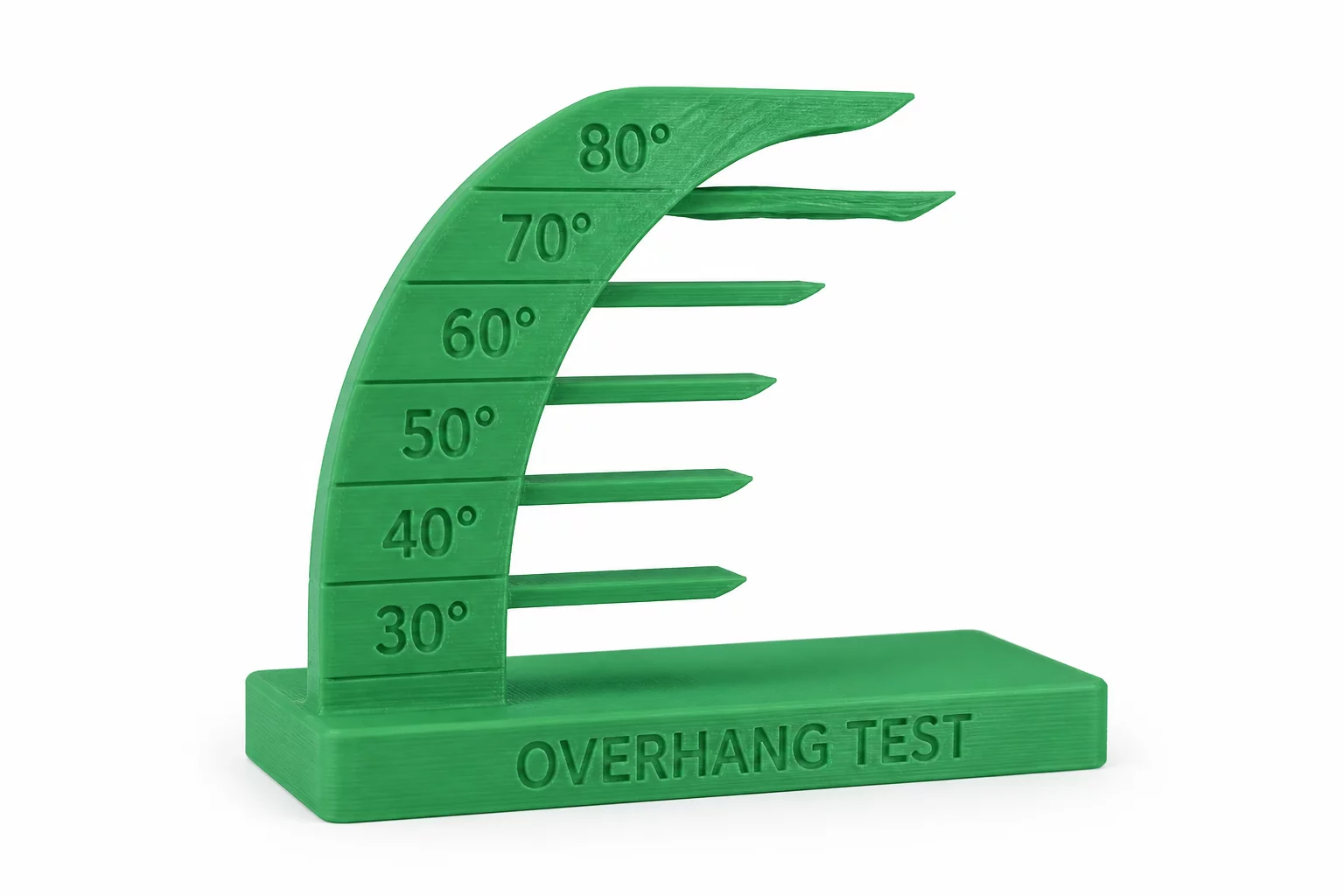
PLA (Polylactic Acid) remains the most common filament in FDM printing, yet its limitations in unsupported geometry often lead to failed prints or poor surface finishes. This trial report documents the performance of standard PLA at various overhang angles, ranging from a conservative 30 degrees to an extreme 80 degrees. The primary goal was to establish a "safe zone" for engineering prototypes where support structures could be minimized without sacrificing structural integrity or visual quality.
Environmental and Slicer Parameters
Success in overhang printing is heavily dependent on cooling. During this trial, we utilized a standard 0.4mm brass nozzle with a layer height of 0.2mm. The extrusion temperature was maintained at a steady 200°C, while the print bed was set to 60°C. Most importantly, the part cooling fan was set to 100% after the first layer. Otherwise, even a 10% reduction in fan speed significantly increased the drooping observed at 60-degree angles.
Angle Analysis (30° to 80°)
The results were clear and reproducible across three separate test prints. These measurements provide a reliable baseline for team handoff notes:
- 30 to 45 Degrees: The surface finish remained pristine. No noticeable sagging or layer misalignment occurred.
- 50 to 60 Degrees: Minor "looping" began to appear on the underside of the overhang. While acceptable for internal components, these surfaces would require post-processing for aesthetic parts.
- 70 Degrees and Above: Catastrophic failure. The molten plastic failed to bond with the previous layer effectively, leading to messy strands and total loss of geometry.
Optimizing for Handoff
When moving from trial to production, it is vital to record these limits in the context notes. For this specific PLA batch, we recommend a maximum unsupported angle of 55 degrees to maintain industrial standards. Designs requiring steeper angles should incorporate chamfering or tree supports to preserve the underside quality. Check the retraction settings in tandem with cooling to ensure that travel moves do not pull on these delicate, unsupported edges during cooling.
Trial Discussion
1James D. Sterling
05/20/2026The precision of the industrial design system described here is exactly what we need for our aerospace prototypes. The integration between technical handoff and the visual hierarchy looks seamless.
Add to the Context
To leave a comment, please log in to your account.