Bridging Performance Review
An in-depth analysis of how to achieve unsupported spans, optimize cooling fan dynamics, and adjust extrusion rates for superior 3D printed results.

Defining Bridging Success
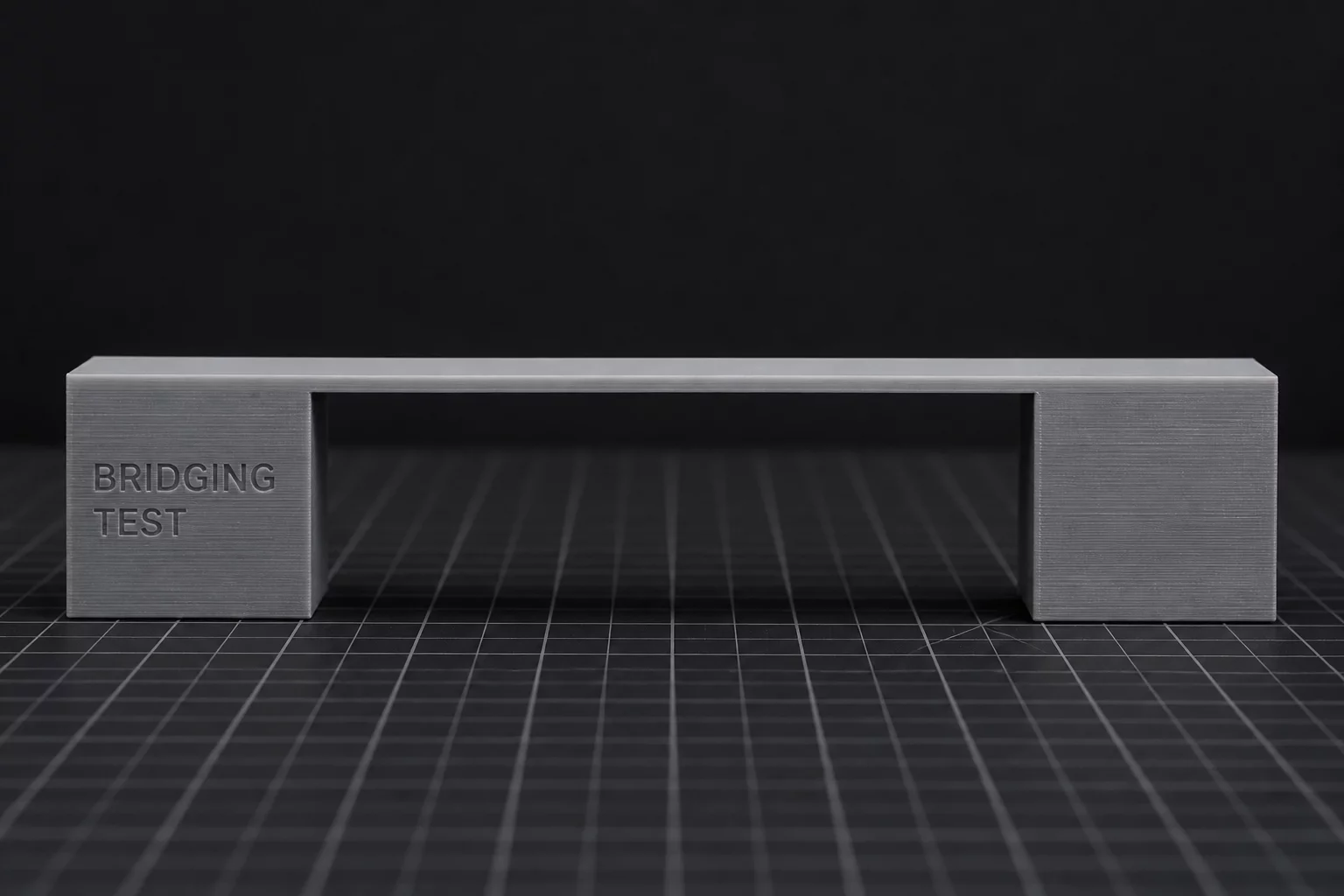
Bridging refers to the extrusion of filament across an open space, connecting two pillars or anchors without the assistance of support structures. Achieving a successful bridge requires a precise equilibrium between material physics and machine control. The primary objective is to solidify the extruded plastic as quickly as possible to prevent gravity from causing significant sagging, while maintaining enough tension to ensure the strand does not snap before reaching the anchor point.
Critical Factors: Cooling and Airflow
Efficient cooling is the most critical variable in any bridging performance review. Without immediate thermal reduction, the thermoplastic remains in a semi-liquid state and inevitably yields to gravitational pull. While a 100% cooling fan speed is typical for PLA, materials like PETG or ABS require modulated cooling to avoid brittle adhesion or warping at the anchor points. It is often necessary to trigger the fan specifically during bridging moves to preserve overall structural integrity without compromising layer bonding elsewhere in the part.
Extrusion Rates and Flow Ratios
Adjusting the bridging flow ratio is a sophisticated technique used to optimize span quality. By slightly reducing the amount of plastic extruded during a bridge—typically to 0.90 or 0.95—the printer creates a thinner, lighter strand that is less prone to drooping. However, this reduction must be balanced carefully. Excessive under-extrusion leads to "hollow" bridges or failures where the filament fails to bond with the destination pillar. Analyzing the cross-section of failed bridges often reveals whether the issue was thermal (cooling) or mechanical (flow).
Speed vs Quality Tradeoffs
The speed at which the nozzle travels across the gap directly impacts the tension of the extruded strand. Moving too fast may cause the filament to tear or fail to stick to the initial anchor. Conversely, moving too slowly allows heat to linger over the unsupported span, increasing deformation. A moderate speed, usually between 20mm/s and 40mm/s, provides the best results for spans exceeding 20mm. Engineers should review every iteration to identify the point where speed creates diminishing returns in surface finish.
Trial Discussion
0No observations have been recorded for this trial yet. Be the first to add to the context.
Add to the Context
To leave a comment, please log in to your account.